Understanding the Framework That’s Transforming Fire Safety Professionalism
The British Standards Institution (BSI) published BS 8674:2025 in August 2025, marking a watershed moment for fire safety in the UK. For the first time, fire risk assessors have a clear, nationally recognised framework that defines what it means to be competent in assessing fire risk across different building types.
Why This Matters
Following the 2017 Grenfell Tower tragedy and subsequent regulatory reforms, BS 8674:2025 addresses a critical gap by establishing measurable standards for the competence of fire risk assessors. This ensures that the complexity of a building matches the assessor’s competency.
What is BS 8674:2025?
BS 8674:2025 – titled “Built Environment – Framework for Competence of Individual Fire Risk Assessors – Code of Practice” – provides a structured framework for assessing the competence of individual fire risk assessors working in the built environment. Developed through extensive industry collaboration led by the Fire Sector Confederation, this standard sets performance-based criteria for determining whether someone is suitably competent to conduct fire risk assessments.
Importantly, BS 8674 doesn’t tell you HOW to conduct a fire risk assessment; that’s covered by standards like PAS 79-1 and BS 9792. Instead, it defines WHO is competent to conduct them based on knowledge, experience, skills, and behaviours.
The Three Levels of Competence
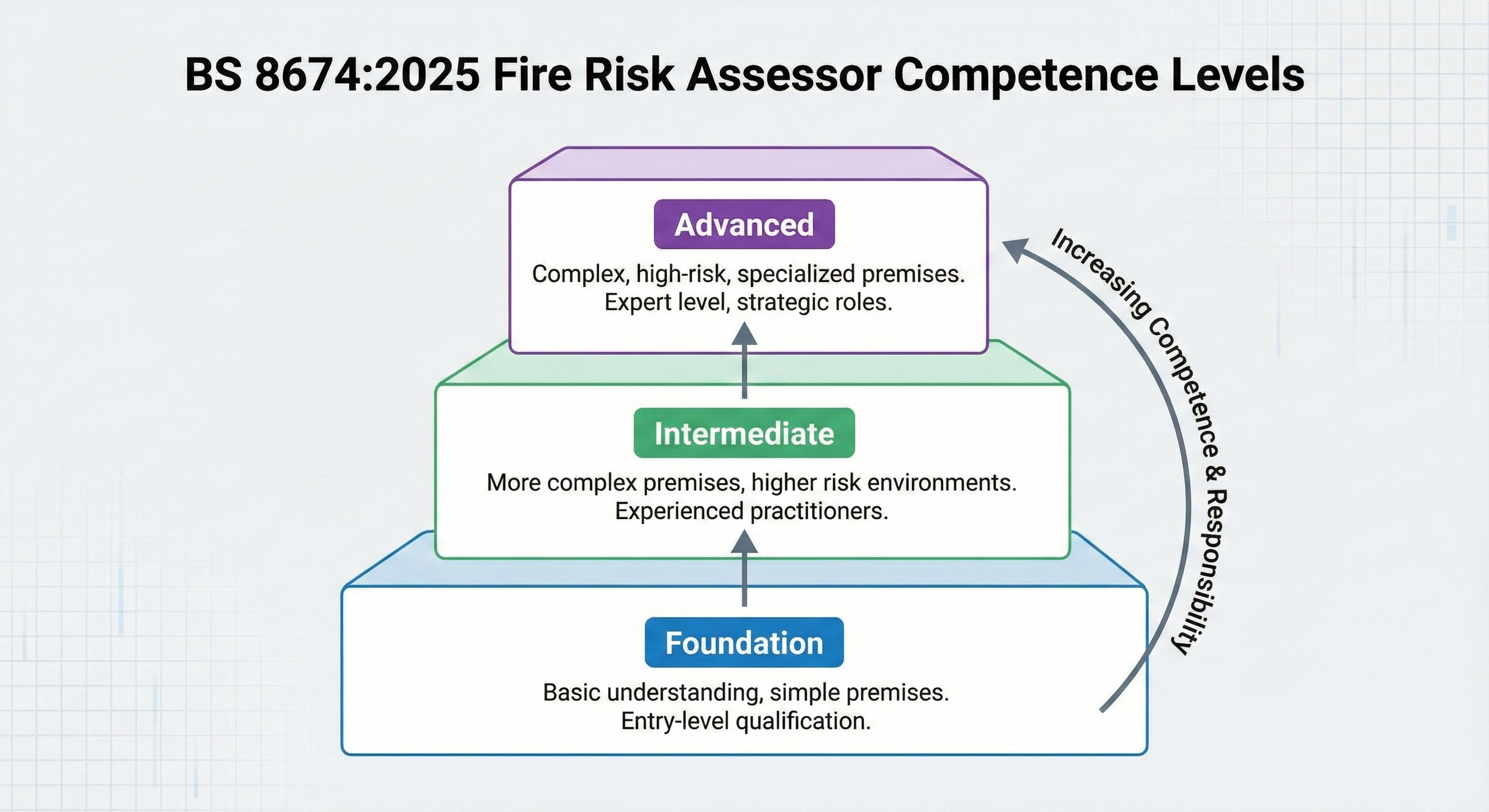
The standard establishes three progressive competence levels, each aligned with building complexity and risk:
Foundation Level
For whom: New entrants to the profession and those assessing simple, low-risk premises.
Building types: Small offices, retail shops, and simple commercial premises with straightforward layouts and limited occupancy.
Intermediate Level
For whom: Assessors with greater experience handling medium complexity buildings.
Building types: Public venues, mid-rise residential properties, premises with moderate fire risk and more complex fire safety systems.
Advanced Level
For whom: Highly experienced professionals working in complex, high-risk environments.
Building types: Large residential blocks, nursing homes, hospitals, multi-occupancy buildings, high-rise structures, and premises requiring advanced risk understanding.
What BS 8674 Covers (and Doesn’t Cover)
The Standard Includes
- Knowledge requirements for understanding building construction, use, and occupancy.
- Skills for evaluating fire risk through systematic analysis.
- Ability to identify fire prevention, protection, and safety management measures.
- Competence in interpreting documentation, including prior reports and maintenance records.
- Professional behaviours and ethical standards are expected at each level.
The Standard Excludes
- Fire risk appraisals of external wall constructions (covered by PAS 9980).
- Assessments requiring destructive inspection or invasive testing.
- Fire engineering services and calculations.
- Design, testing, or maintenance of fire protection systems.
- Competence of organisations (it applies to individuals only).
- Specialist environments like nuclear facilities.
Note: BS 8674 is based on non-invasive fire risk assessments conducted through visual examination and information gathering. These are the standard assessments required under the Regulatory Reform (Fire Safety) Order 2005 and Building Safety Act 2022.
The Legal Context (UK)
BS 8674:2025 directly supports compliance with the Building Safety Act 2022, which requires that individuals appointed to carry out fire risk assessments must be competent. The standard provides measurable, verifiable benchmarks for this competence, helping duty holders (Responsible Persons) demonstrate that they’ve appointed appropriately qualified assessors.
The standard aligns with broader regulatory reforms following Grenfell, including:
- Fire Safety Act 2021
- Building Safety Act 2022
- Fire Safety (England) Regulations 2022
- BS 8670-1:2024 (competency framework for building safety)
The UK government has signalled its intention to require independent third-party certification of fire risk assessor competence, making BS 8674 a likely foundation for future professional regulation.
The Legal Context (Ireland)
While BS 8674:2025 is a UK British Standard, it is highly relevant to fire safety professionals in Ireland. Understanding both Irish legislation and BS 8674 in the Irish context is essential for fire risk assessors and duty holders.
Irish Fire Safety Legislation
Several key pieces of legislation govern fire safety in Ireland:
- Fire Services Acts 1981, 2003 & 2018 – The primary legislation governing fire safety in buildings. Section 18(2) places a duty of care on “every person having control over premises” to:
- Take all reasonable measures to guard against fire outbreaks.
- Provide reasonable fire safety measures and procedures.
- Ensure these measures are applied at all times.
- Ensure the safety of persons in the event of fire.
- Safety, Health and Welfare at Work Act 2005 – Requires employers to ensure workplace safety, including fire risks. Section 19 mandates risk assessments, including fire safety assessments.
- Building Regulations 1997 to 2021 – Technical Guidance Document B (TGD-B) provides detailed requirements for fire safety in building design, including detection systems, emergency lighting, and firefighting equipment.
- Building Control Acts 1990 & 2007 – Require Fire Safety Certificates for new buildings and significant alterations.
Competence Requirements in Irish Law
While Irish legislation requires that fire risk assessments be conducted by “competent persons”, there is currently no formal Irish standard or framework that defines what constitutes competence at different levels, unlike the tiered approach introduced by BS 8674 in the UK.
This absence of a structured competence framework in Irish legislation means that:
- Determining assessor competence is left largely to professional judgment.
- Duty holders must independently verify an assessor’s qualifications and experience.
- There is no nationally agreed benchmark for matching assessor capability to building complexity.
- Professional bodies and certification schemes operate without a unified competence standard.
How BS 8674 Relates to Ireland
While BS 8674:2025 is not Irish legislation and has no legal force in Ireland, it serves as a best-practice framework that Irish fire safety professionals can voluntarily adopt to demonstrate competence. Many Irish fire risk assessors already reference UK standards such as PAS 79 (fire risk assessment methodology), and BS 8674 can serve a similar role as a competence benchmark.
The standard is particularly relevant in Ireland because:
- It fills a competence gap: BS 8674 provides the structured, measurable framework that Irish legislation currently lacks.
- Cross-border consistency: Many Irish fire safety companies work in both Ireland and Northern Ireland/UK, where BS 8674 will likely become more influential.
- Professional credibility: Demonstrating compliance with internationally recognised standards enhances assessor credibility and client confidence.
- Future-proofing: If Ireland develops its own competence framework, it may reference or align with BS 8674 principles.
- Insurance and procurement: Some insurers and large organisations may begin requesting evidence of BS 8674-level competence.
The Irish Context Going Forward
While Ireland has not yet adopted a formal competence framework equivalent to BS 8674, the standard provides valuable guidance for Irish fire risk assessors seeking to demonstrate their capability and for duty holders looking to verify assessor competence. As professional standards evolve globally, frameworks like BS 8674 may influence future Irish policy development in this area.
For Irish fire safety professionals, voluntary alignment with BS 8674 principles offers a proactive approach to competence demonstration, particularly for those working with complex or high-risk buildings where the stakes are highest.
Who Benefits from BS 8674?
For Fire Risk Assessors
- A clear career progression pathway from Foundation to Advanced.
- A structured framework to demonstrate capability.
- Benchmark for seeking certification or professional recognition.
- Clarity on which building types match their competence level.
For Responsible Persons and Duty Holders
- Confidence that assessors have appropriate qualifications for specific buildings.
- A reference standard for verifying assessor credentials.
- Support for legal compliance with the Building Safety Act 2022 (UK), Fire Services Act 1981 (as amended 2003) – (Ireland).
- Assurance of quality and consistency in fire risk assessments.
For Professional Bodies and Certification Schemes
- Framework for validating member competence.
- Guidance for membership criteria and CPD development.
- Reference for third-party verification schemes.
- Objective criteria for audits and renewals.
For Training Providers
- Clear competence requirements for curriculum development.
- Alignment of qualifications with industry expectations.
- Support for learners transitioning into professional roles.
Industry Response
“The introduction of BS 8674:2025 marks a significant step forward in the collective effort to make buildings safer for residents. I’m grateful to the British Standards Institution and all of the Technical Committee members who’ve been involved in making this happen.” and “The publication of BS 8674 is a significant achievement for the profession and a vital step towards building a safer future. It gives all stakeholders confidence that competence can now be clearly demonstrated against a professional framework capable of independent verification.”
Alex Norris, Minister for Building Safety and Fire
Fire Risk Profiles: A Critical Component
BS 8674 introduces formal fire risk profiles that classify premises as low, moderate, or high fire risk. While these terms existed in earlier guidance, BS 8674 provides specific definitions and thresholds that directly link to competence requirements:
- Low-risk premises require Foundation-level competence.
- Moderate-risk premises require intermediate-level competence.
- High-risk premises require advanced-level competence.
This matching principle ensures buildings receive appropriate scrutiny from assessors with suitable expertise for the complexity and risk involved.
Dennis Davis, Competence Director, Fire Sector Confederation
Looking Ahead
BS 8674:2025 represents a fundamental shift toward professionalising fire risk assessment in the UK and Ireland. By establishing transparent, measurable competence criteria, it:
- Reduces variability in assessor qualifications across the industry.
- Enhances public safety through consistent, quality assessments.
- Supports career development and professional recognition.
- Lays the groundwork for potential regulatory requirements.
- Improves accountability throughout the building lifecycle.
For those working in fire safety, whether in the UK, Ireland or internationally, BS 8674 offers a model of how competence frameworks can drive professional standards and, ultimately, save lives.
International Context: While BS 8674 is a UK standard, its principles of tiered competence, clear career progression, and matching assessor capability to building complexity provide valuable insights for fire safety professionals globally. Similar competence frameworks may emerge in other jurisdictions as regulatory expectations evolve.
Phoenix STS Fire Risk Assessment Services
At Phoenix STS, we recognise the importance of competent, thorough fire risk assessments that align with best practice standards. Our team of qualified fire safety professionals conducts comprehensive PAS 79-2020 Fire Risk Assessments across a wide range of commercial and residential premises throughout Ireland. For healthcare facilities, we specialise in Nursing Home PAS 79-1 Fire Risk Assessments, understanding the unique challenges and regulatory requirements of these vulnerable occupancy environments. Our assessments provide clear, actionable recommendations that help duty holders meet their obligations under Irish fire safety legislation while ensuring the highest standards of life safety protection. Whether you’re responsible for a simple office building or a complex healthcare facility, Phoenix STS delivers fire risk assessments that combine technical expertise with practical, implementable solutions tailored to your specific premises and risk profile.
Resources
Copies of BS 8674:2025 are available for purchase from the BSI website at www.bsigroup.com
For more information on related standards:
- PAS 79-1: Fire risk assessment guidance for buildings other than housing
- BS 9792:2025: Fire risk assessment for housing
- BS 8670-1:2024: Framework for competence of building safety professionals
- PAS 9980: Fire risk appraisal of external walls
This article provides an overview of BS 8674:2025 for informational purposes. Fire safety professionals should consult the full standard for complete guidance. For specific advice on competence requirements for fire risk assessment, please consult qualified professionals or relevant regulatory authorities.